

Nepal just secured major international backing to tackle one of its most urgent public health crises.
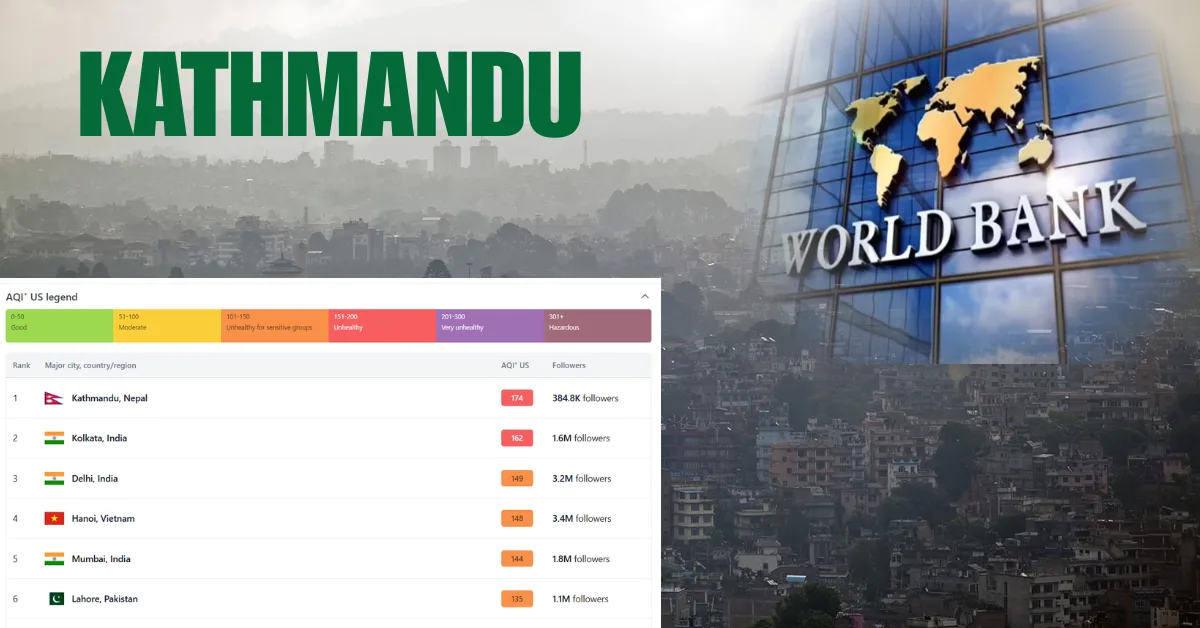
The World Bank’s Board of Executive Directors approved $52 million in financing on March 11 for the Nepal Clean Air and Prosperity Project. The funding comes through the International Development Association, the World Bank’s concessional lending arm for lower-income countries, and amounts to approximately Rs 7.07 billion.
Air pollution kills around 26,000 Nepalis prematurely every year, cuts life expectancy by an estimated 3.4 years, and costs the economy more than 6 percent of GDP annually. Kathmandu Valley and the Terai bear the worst of it, hit by a combination of industrial emissions, brick kilns, vehicle exhaust, biomass burning, and transboundary pollution drifting in from across the border.
Where the Money Goes
The project’s primary target is industrial pollution. Around 400 enterprises across food and beverage, textiles, chemicals, steel, hospitality, and healthcare sectors will receive support to replace old boilers, furnaces, and kilns with cleaner alternatives such as electric systems, pellet-based units, or equipment fitted with emission controls like bag filters and wet scrubbers.
A dedicated Clean Air Financing Facility, operating through commercial banks, will provide loans and financial incentives for businesses making the switch. Smaller enterprises that cannot afford upfront retrofitting costs will have a structured pathway to upgrade.
Beyond industry, the project funds air quality monitoring infrastructure, stronger enforcement capacity, and emergency response mechanisms for pollution crises. The Ministry of Forests and Environment leads implementation alongside the Department of Environment and the Ministry of Industry, Commerce, and Supplies.
Why This Approval Matters Now
Nepal’s new government under RSP is inheriting a country where clean air has become a political as well as an environmental issue. Kathmandu’s pollution levels regularly make regional headlines, and Terai residents have long pushed for industrial accountability.
The project was in preparation since late 2024, with earlier estimates reaching $147 to $155 million, but the final $52 million credit cuts straight to the highest-impact targets first. That makes it easier to deliver results fast, exactly what a new government needs.
Also Read: Balen Shah Responds to Bhutan PM, Calls for Stronger Nepal-Bhutan Ties